By: Jacob Kim
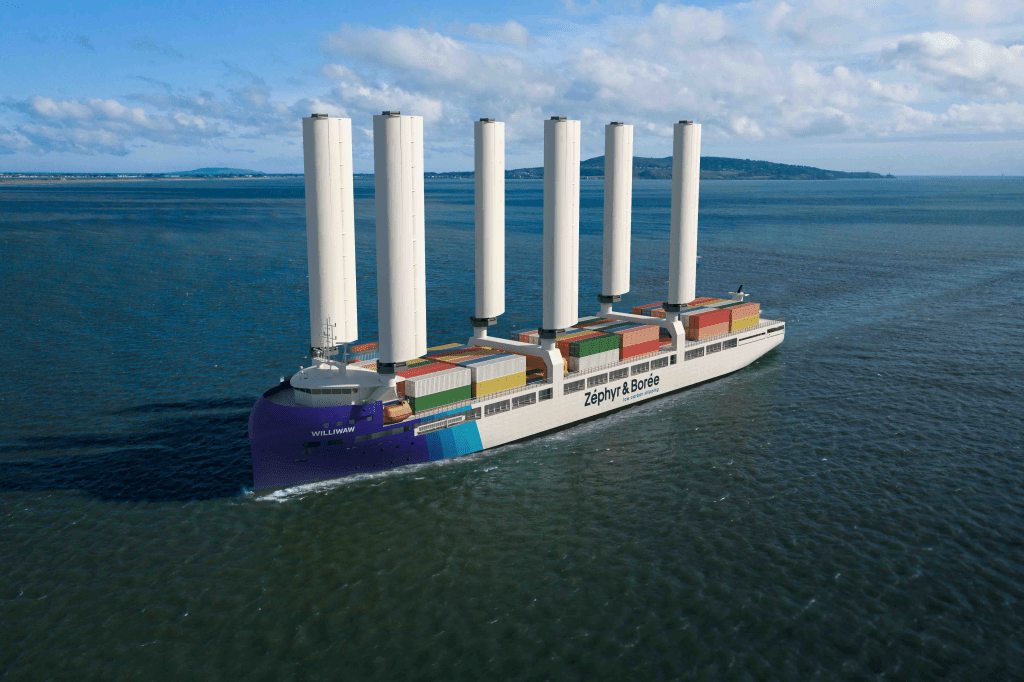
A revolutionary chapter in maritime transport is underway, and it’s being written not by fossil fuels, but by wind. The world’s first sail-powered containership—built through the French cooperative Windcoop—is more than just a sleek vessel with 11,300 square feet of wing sails. It’s a signal flare for a shipping industry at a crossroads, and a critical climate and policy milestone in the global transition to renewable energy.
This vessel, designed with asymmetrical sails, open-hatch architecture, and integrated cranes for autonomous loading and unloading, is a feat of engineering. But it’s also a direct challenge to the diesel-dominated, high-emissions cargo sector that accounts for nearly 3% of global greenhouse gas emissions—a figure expected to rise sharply if left unchecked. With average speeds of 9 knots and a capacity of 210 TEU (Twenty-Foot Equivalent Units) and 40 refrigerated containers, this ship might not be massive by today’s mega-freighter standards—but its impact could be enormous.
The climate implications are profound. Unlike electric vehicles or even hydrogen trains, the decarbonization of maritime freight has lagged due to the sheer scale and energy demands of oceangoing vessels. Windcoop’s sail-powered ship disrupts this inertia by offering a simple yet elegant solution: return to the oldest renewable resource in human transport history—the wind—and pair it with modern efficiency and sustainability standards.
This isn’t just about emissions reductions. It’s about rewriting the logistics map. By targeting overlooked secondary ports and minimizing the need for transshipment and long-haul ground transportation, the ship’s route between Marseille and ports in Madagascar—via the Suez Canal—shows how green shipping can also democratize global trade. It strengthens north-south trade relationships without reinforcing extractive infrastructure patterns that have historically marginalized smaller economies.
From a policy standpoint, the project is even more significant. The cooperative financing model—bringing together individuals, institutional investors, and commercial shippers—marks a paradigm shift in how green infrastructure can be funded. The $31.2 million (€28.5 million) construction cost wasn’t backed by oil giants or shipping conglomerates. It was powered by community, ethics, and public-private synergy, with support from a state financial institution and a regional marine bank.
This is the first time a cooperative has financed a cargo ship of this scale, and the implications are massive: it decentralizes power in the shipping sector, encourages civic participation in climate action, and proves that sustainability doesn’t have to wait for billion-dollar unicorns to lead the charge.
And this is just the beginning. Windcoop’s initiative signals a resurgence of sail logistics—not as a nostalgic callback to a bygone era, but as a scalable, efficient, and politically viable strategy for meeting international climate targets like the IMO’s goal of net-zero shipping by 2050. It also aligns perfectly with the European Green Deal, and could inform upcoming maritime policy shifts in the U.S., Asia, and Africa.
As the vessel prepares for full operation between 2026 and 2027, with parts orders underway and sea trials slated for 2027, its launch will serve as a working proof-of-concept. If successful, it may catalyze a movement—one where clean shipping is not a luxury or a future dream, but a real, operationally sound present.
In the fight against climate change, no sector can afford to be left behind. Wind-powered shipping is a clear reminder that innovation doesn’t always mean new—it sometimes means smarter. This ship, blending old-world propulsion with modern sustainability and logistics innovation, charts a new course for renewable energy and global trade alike. It asks a bold question that global policymakers must now answer: if wind can carry the weight of cargo across oceans, what’s stopping us from letting it carry the weight of the future too?
Sources
https://interestingengineering.com/innovation/world-first-open-hatch-sail-powered-containership
 Energy Outlook
Leave a comment