By: Jacob Kim
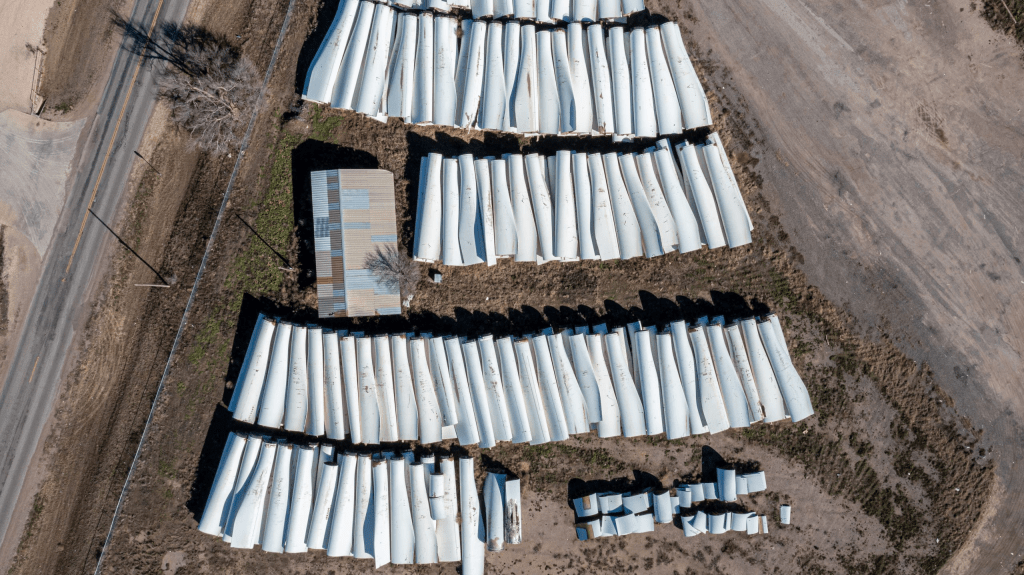
Wind power has long been championed as a clean energy solution, harnessing nature to drive our shift away from fossil fuels. But behind the spinning turbines and carbon-free electricity lies a less visible issue that critics have latched onto: what happens when the blades stop turning?
Until now, wind turbine blade disposal has posed a serious environmental challenge. Made of durable glass fiber-reinforced polymers (GFRPs), these blades are engineered for performance—but not for easy recycling. As the first wave of wind farms enters retirement, with tens of thousands of massive blades reaching the end of their 30-year lifespan, waste has piled up. Landfilling them poses risks of microplastic pollution, and the lack of scalable recycling solutions has threatened to tarnish wind energy’s green reputation.
That’s what makes this new development so exciting—and potentially game-changing.
Scientists at Washington State University (WSU) have unveiled a low-toxicity, scalable recycling process that could rewrite the end-of-life narrative for wind turbine blades. Their method, which uses superheated water and zinc acetate (a food-safe compound commonly found in throat lozenges), avoids harsh chemicals and high energy costs. Instead of trying to break down every chemical bond in the polymer matrix—a typically difficult, energy-intensive process—they’ve discovered that partial breakdown is enough to repurpose the material into stronger, more versatile plastics.
The resulting composite isn’t just reusable—it’s superior. When blended with nylon, the recycled material became three times stronger and eight times stiffer than nylon alone. It also proved compatible with everyday plastics like polypropylene and HDPE, meaning it could be transformed into durable consumer goods or even reused in new wind turbine designs.
This breakthrough arrives at a critical moment for the wind industry. As clean energy infrastructure scales up globally, sustainability at every stage of the turbine lifecycle—from design to decommissioning—is under increasing scrutiny. Detractors have pointed to blade waste as a key weakness in wind’s eco-credentials.
But now, we have an answer.
This method shows that wind energy can not only power a circular economy—it can participate in one. By turning blade waste into high-performance materials, the process effectively closes the loop, reducing landfill impact and enhancing the value of wind energy as a sustainable system.
Even more promising is that this process is designed with scalability and sustainability in mind. It recovers most of the zinc acetate catalyst through simple filtration, making the method both cost-effective and environmentally sound. The WSU team is already working on ways to reduce energy input and adapt the process for even broader use.
Simultaneously, researchers are pushing to design next-generation turbine blades that are recyclable from the start—a radical shift from the legacy designs of the past. Imagine a future where every wind turbine is built with reuse in mind, and every old blade fuels new construction, creating an endless, regenerative energy cycle.
For years, one of the few criticisms of wind power that stuck was the problem of blade disposal. This new method doesn’t just solve that—it transforms it into an asset. With this technology, wind energy moves beyond being “clean” in operation to being clean by design, from installation to retirement and reuse.
As the urgency of climate change accelerates and the oil markets spiral with political instability, solutions like this make it undeniably clear: wind power is not just viable—it’s unstoppable. This is innovation meeting necessity.
Sources
https://indiandefencereview.com/low-toxic-repurpose-wind-turbine-blades/
https://interestingengineering.com/innovation/wind-turbine-blades-recycled-strong-plastics
 Energy Outlook
Leave a comment