By: Jacob Kim
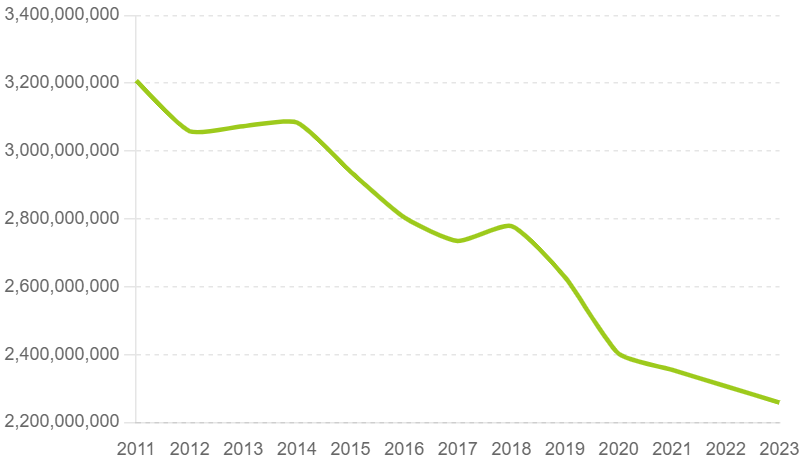
The recent UN report detailing record-breaking carbon dioxide levels in 2023 underscores a troubling truth: despite global efforts to adopt renewable energy, emissions continue to rise. In particular, the United States, one of the world’s largest historical emitters of greenhouse gases, has struggled to keep pace with the urgency of climate change. While other nations are advancing with aggressive renewable energy policies, such as large-scale solar projects in Australia and offshore wind farms in China, the U.S. response remains piecemeal, with inconsistent commitments and policy reversals that hinder progress.
The World Meteorological Organization (WMO) found that global CO₂ levels have risen 11.4% in just two decades, with concentrations hitting an average of 420 ppm in 2023—levels not seen for millions of years, when Earth was significantly warmer and sea levels were much higher. Factors like extensive fossil fuel use, increased vegetation fires, and diminished forest absorption capacities have all contributed. Yet, in the U.S., climate policy often lacks cohesion due to political divides and a strong fossil fuel lobby that stymies ambitious action. The recent Inflation Reduction Act marked a step forward in clean energy incentives, but even this falls short compared to the sweeping, government-led initiatives seen in other countries.
The impact of this inaction goes beyond statistics. Every fraction of a degree in temperature rise leads to tangible consequences—extreme weather events, rising sea levels, and ecosystem degradation. WMO officials warn of a potential feedback loop, where climate change weakens ecosystems’ ability to absorb CO₂, potentially transforming them into net emitters. Inaction only accelerates this cycle.
As the world prepares for the next climate negotiations, the United States faces a critical moment to reassert its commitment to climate leadership. Failing to act now leaves the U.S. not only behind the curve but also accountable for a disproportionate share of the damage to future generations.
Sources
https://www.axios.com/2024/10/28/greenhouse-gases-2023-record-high
 Energy Outlook
Leave a comment